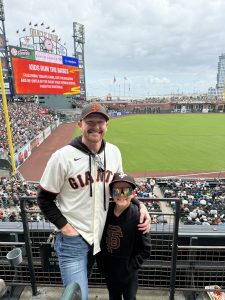
Mystery solved!
Meet Dr. David Raleigh, one of the brilliant UCSF researchers we champion. To cap off May’s Brain Tumor Awareness Month, Meningioma Mommas delivered a fresh $5,000 grant to his lab—officially pushing our lifetime support for UCSF meningioma research to a massive $65,000!
Because Dr. Raleigh is working around the clock saving lives and running his lab, I caught up with him digitally for a rapid-fire Q&A between his rounds. We talked about his high-stakes mission to decode these tumors using AI, his insistence on personally designing every single scientific figure for his papers, and yes—his reliance on peanut butter pretzels to power through the day when his kids don’t steal them first!
Dive into our exclusive feature below to see how your awareness month support is helping him rewrite the soundtrack for meningioma research.
What led you to devote yourself to meningioma research?
At first, it was a combination of the mentors I had, and the clinical and scientific training I had during my residency and postdoctoral fellowship at UCSF.
Once I joined the faculty at UCSF, it was the patients I met and treated. Meningioma needs more champions in biomedical research and clinical care, and I’m happy to play a small part in what needs to be a much larger effort to improve diagnostic and treatment paradigms for patients.
What keeps you motivated to further investigate these tumors?
The patients and the science. Almost every patient with a brain tumor that I see these days has a meningioma, and most brain tumor doctors don’t have the luxury of getting to know their patients, and seeing them thrive, as much as I do.
On a fundamental level, the biology of meningioma is also very interesting and unique. So my motivation, said another way, comes from a combination of human interactions and scientific intrigue.
When you’re not in the confines of your lab, how do you like to spend your time/reset/disconnect?
With family and, if I’m lucky, friends. We have kids who are 6- and 9-years old, and baseball and skiing are big parts of our life depending on the time of year.
Most of my friends also work in biomedical research, and so most of our interactions are at work or conferences for work, which is a nice albeit temporary distraction.
Imagine you’re explaining your research to a curious friend at a coffee shop/pub/Giants game—what’s the “elevator pitch” version?
My lab is focused on understanding genomic, biochemical, and cellular drivers of brain tumor heterogeneity and evolution. To do so, my lab integrates human samples with evolutionarily-diverse preclinical models to understand brain tumor biology and develop new biomarkers and new treatments for patients.
What’s the most unexpected or fascinating challenge you’ve encountered in your lab recently?
Figuring out how best to integrate AI to address longstanding scientific questions.
If you could have one superpower to accelerate your research, what would it be and why?
Accelerating clinical translation of scientific discoveries from the lab.
What’s the most interesting thing on your desk right now?
Meningioma sex specificity and hormone signaling.
If your research had a theme song, what would it be?
Oh man… that’s a good question. I listen to a lot of different types of music – jazz, rap, rock, country – you name it. The type of music I listen to depends on what I’m working on and who I’m with… so it’s hard for me to pick a single theme song. We’d probably need a whole soundtrack!
Go to power food/snack, etc. when you hit that proverbial wall?
Peanut butter pretzels… provided my kids don’t eat them all first.
Quirky habit people are surprised about you?
I have made every figures for every paper my lab has ever published.
Thank you again for your generous time and here’s to more out-of-the-lab quality time with your family.